For years, Iowa sat quietly within America’s digital infrastructure. Fiber crossed the state, but few companies considered it a prime data center destination. That has changed. Iowa is emerging as one of the nation’s key data center hubs supporting cloud and AI development.
The turning point came when Google announced major data center investment in Cedar Rapids and expanded further in Council Bluffs. What appeared to be one major project was actually part of a wider shift. Iowa is now a strategic market for hyperscalers, and Google is only one of several companies investing heavily here.
Why Iowa Is Emerging as a National Compute Hub
A combination of long‑range market forces is drawing hyperscalers to Iowa. These factors go beyond short‑term opportunities and point to sustained growth, reliability, and scalability in the region.
Power. Iowa leads the nation in renewable electricity production, with wind energy supplying the majority of the state’s power. This is not a side benefit. AI and cloud platforms require enormous, always‑on energy. Companies are under pressure to run these workloads sustainably, and Iowa’s power profile gives them a reliable, long‑term energy foundation.
Land. Large data centers require hundreds of acres, and they need to grow over time. Iowa offers space, predictable permitting, and a cost structure that allows companies to build at the scale they truly need rather than the scale that dense coastal markets force them into.
Geography. When compute is located in the middle of the United States, the digital distance to major markets becomes noticeably shorter. For AI inference, enterprise workloads, and cloud services, milliseconds matter. Iowa’s location gives operators a performance advantage that improves reliability for users nationwide.
These structural advantages explain why the world’s largest tech companies continue to bet heavily on Iowa’s future rather than treating it as a supplemental region.
A Cluster That Has Taken Shape
Across Iowa, a new wave of development is taking hold. The state is seeing larger‑scale, coordinated data center growth than ever before.
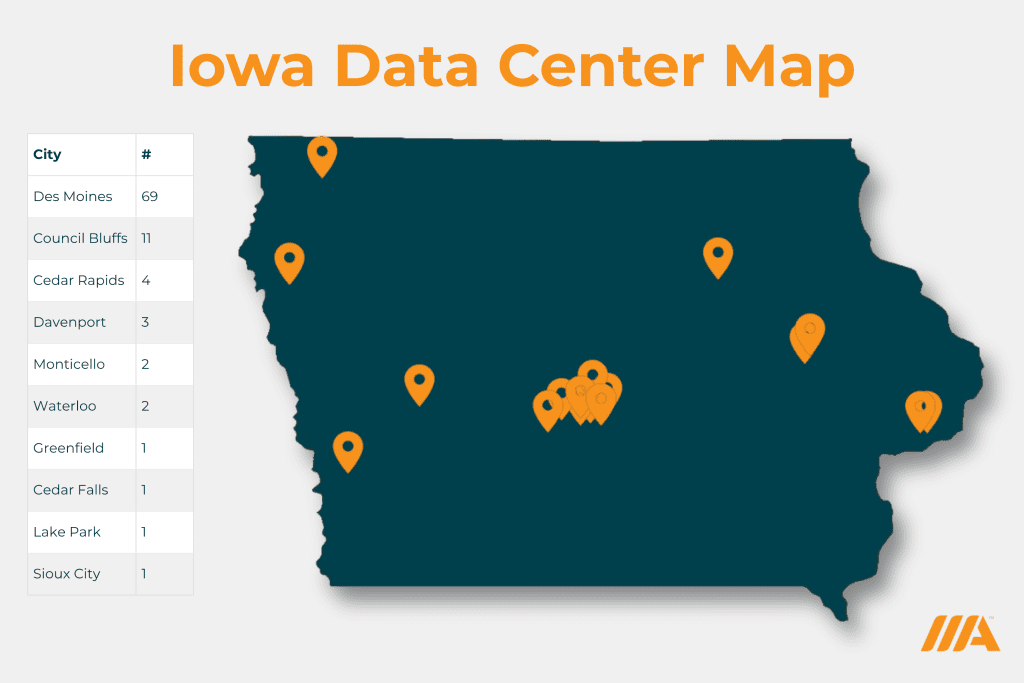
Meta’s Altoona campus has expanded steadily since 2013 and is now the company’s largest data center footprint in the United States, running entirely on renewable energy.
Microsoft’s West Des Moines presence tells a similar story. Multiple campuses have been built in the region, and the company recently received approval for its sixth facility, reinforcing Iowa’s role as a long-term strategic location.
Google’s footprint has grown from Council Bluffs into Cedar Rapids, positioning compute capacity on both sides of the state.
Cedar Rapids has emerged rapidly. QTS announced one of the largest projects in state history, and Google is building directly alongside it. This shift moved Cedar Rapids from a secondary market to a primary one within a short period.
This is no longer a scattering of isolated facilities. It is a connected region of hyperscale infrastructure that rivals more established national markets.
What This Means for Iowa
The economic impact of this buildout is already visible. Data processing and hosting has become one of the fastest growing sectors in the state and now surpasses industries such as gaming across major economic measures.
More importantly, these data centers attract an ecosystem around them. Engineering firms, trades programs, fiber providers, local colleges, and support industries all benefit from the scale and longevity of hyperscale builds. This creates steady, long-term value rather than short bursts of construction activity.
These developments help redefine Iowa’s economic identity. Technology infrastructure is becoming a core growth engine, not a peripheral one.
The Critical Advantage Will Be Connectivity
As Iowa becomes home to some of the most powerful compute clusters in the country, a key question emerges. The infrastructure is here, but who can reach it?
Proximity does not equal access. Organizations need high capacity, low latency, resilient connectivity pathways into these facilities. The data centers support AI models, cloud platforms, analytics engines, workflow systems, and enterprise applications. Without the right network routes, being located close to this infrastructure does not translate into advantage.
Some organizations in Iowa will unlock meaningful performance improvements, cost efficiencies, and competitive advantages simply because they can connect directly into these hyperscale environments. Others will be geographically close but technically distant.
Connectivity is turning into a strategic choice rather than a background utility. The leaders who see that change will be best positioned as Iowa’s digital landscape expands.
Signals Leaders Should Watch
Several emerging trends will shape Iowa’s next phase. These changes will influence how Iowa businesses operate and how communities plan for the future:
• AI workloads are spreading across more distributed compute environments, increasing the value of regional proximity.
• Fiber routing and interconnect decisions made today will determine which communities will become digitally advantaged tomorrow.
• Network performance is becoming a competitive differentiator for industries well beyond technology.
For organizations making long-term technology decisions, these signals point to one conclusion: Iowa’s data center era is only beginning, and the choices made now will shape the next decade of opportunity.
Discover Aureon’s Transport Network