
Cyber threats continue to evolve, but one thing remains consistent: attackers target people first. While many organizations rely on compliance-driven security training to meet requirements, that approach alone is no longer enough. Midwest businesses, especially those with lean IT teams, are seeing firsthand that annual training does not reduce real-world cyber risk.
Managed Security Awareness Training changes that equation by shifting training from a checkbox activity to an ongoing defense strategy.
Why Compliance-Driven Security Training Alone Falls Short
Annual training checks a box but does not change behavior
Traditional security awareness training is often delivered once per year to satisfy compliance requirements. Employees complete the course, pass a quiz, and move on. Within weeks, most of the information is forgotten.
The result is a workforce that technically completed training but is not prepared to recognize real phishing attempts, impersonation emails, or social engineering attacks when they happen.
Key takeaway: Completion does not equal protection.
Threats evolve faster than compliance requirements
Regulations change slowly. Cyber threats do not.
Attackers constantly adjust their tactics, using current events, internal language, and familiar names to make phishing emails more convincing. Static training content cannot keep pace with AI-driven phishing, credential abuse, and impersonation attacks that change month to month.
Key takeaway: Training that does not evolve leaves gaps attackers exploit.
Not sure if your current training actually reduces risk?
What Makes Managed Security Awareness Training from Aureon Different
Continuous training instead of one-time sessions
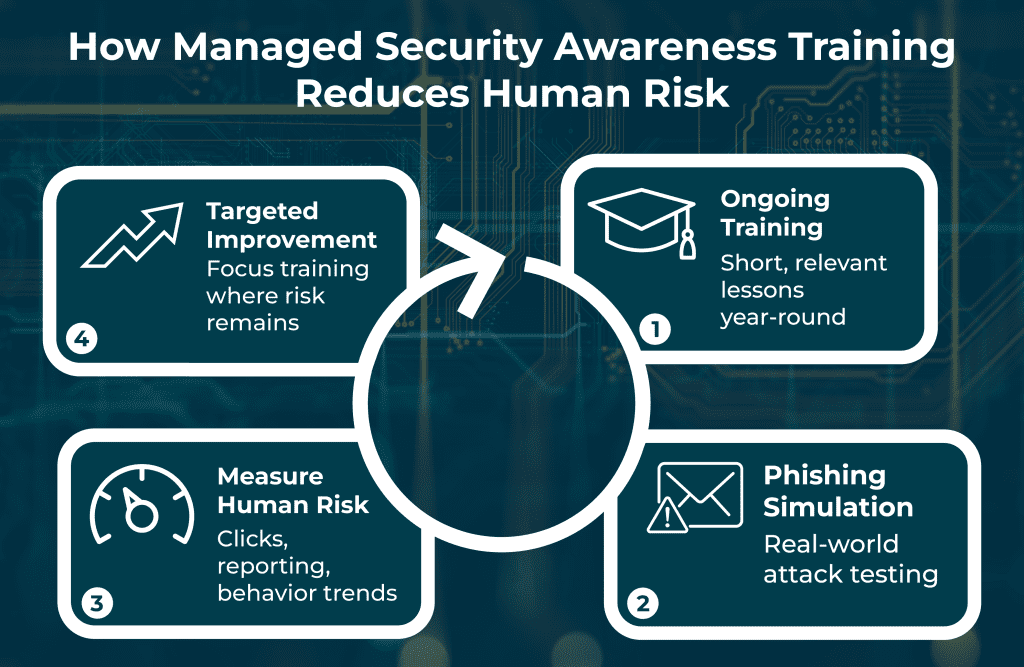
Managed security awareness training delivers short, focused lessons throughout the year. This approach improves retention and keeps employees aware of current threats instead of outdated examples.
Training becomes part of normal operations, not an annual disruption.
Built-in phishing simulation and human risk management
Phishing simulations test how employees actually respond to real-world attacks. These simulations reveal patterns such as repeat click behavior, delayed reporting, or departments that need extra support.
Training is then adjusted based on real behavior, not assumptions. Over time, organizations can track measurable improvement in employee responses and risk reduction.
Reporting that supports audits and leadership visibility
Managed programs provide clear reporting that supports both compliance reviews and leadership discussions. Instead of reporting who completed training, teams can show how risk levels are trending and where improvement is happening.
Key takeaway: Managed training focuses on behavior change, not just attendance.
The Role MSPs Play in Ongoing Cybersecurity Training
Why MSP-focused training solutions scale better
Managed service providers deliver consistency. Training stays current, schedules are maintained, and reporting remains centralized. Internal IT teams are not burdened with managing content updates or chasing completions.
This model works especially well for organizations with multiple locations or limited internal security staff.
Training that fits into a managed security strategy
Security awareness training strengthens existing security controls. When employees know how to recognize and report suspicious activity, incidents are detected faster and response times improve.
People become an active layer of defense alongside technical controls.
Key takeaway: Managed training complements the rest of the security stack.
Cybersecurity Training Challenges Facing Midwest Businesses
Smaller IT teams with growing risk
Many Midwest organizations operate with lean IT teams responsible for a wide range of systems. One security incident can quickly overwhelm limited resources.
Managed security training reduces the internal workload while improving preparedness across the organization.
Why Midwest organizations are targeted more than expected
Attackers do not focus only on large enterprises. Regional businesses are often seen as easier targets because they may lack dedicated security staff.
Email-heavy workflows, cloud adoption, and distributed teams increase exposure regardless of company size.
Key takeaway: Geography does not reduce risks.
Why Industry-Specific Security Awareness Training Works Better
Healthcare
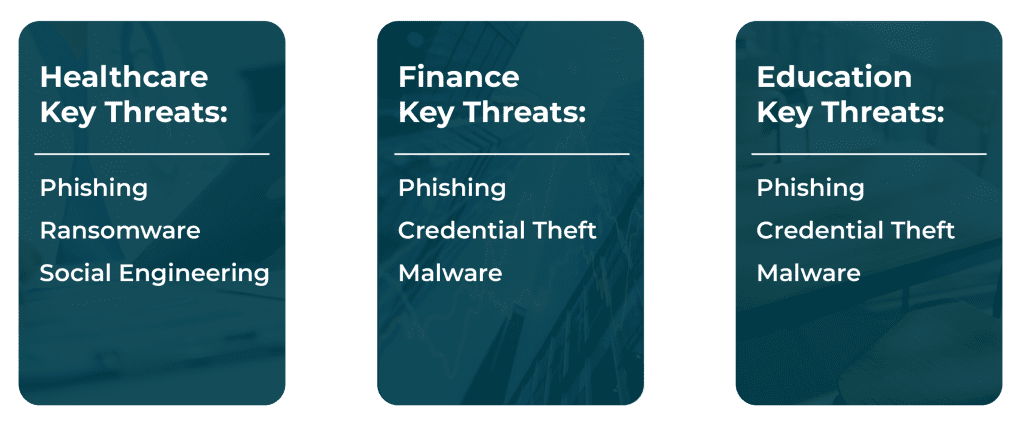
Healthcare teams face constant phishing and impersonation attempts tied to patient data and system access. Training must reflect real clinical and administrative scenarios to be effective.
Finance
Finance teams are prime targets for credential abuse and wire fraud. Training focuses on verification, access awareness, and fast reporting.
Education
Shared systems, frequent user turnover, and limited security staff create unique challenges. Training emphasizes awareness and consistent reporting habits.
Key takeaway: Relevant training improves engagement and retention.
Why Iowa Businesses Are Shifting to Managed Security Training
Organizations across Iowa are moving away from one-time training toward managed security awareness programs that deliver consistent results. Local support, simplified compliance, and measurable risk reduction are driving the shift.
Security awareness training is no longer just about meeting requirements. It is about protecting people, systems, and operations year-round.
Aureon’s Security Awareness Training Goes Beyond a Checkbox
Security awareness training only works when it changes behavior. Aureon’s Security Awareness Training is built to do exactly that. Instead of relying on one-time courses or generic content, Aureon delivers an ongoing program that helps employees recognize real threats, respond faster, and reduce risk across the organization.
By combining continuous education, phishing simulation, and clear reporting, Aureon gives businesses real visibility into human risk. Leaders can see where training is working, where additional focus is needed, and how employee behavior improves over time. This turns security awareness into a measurable part of the overall security strategy rather than a compliance task completed once a year.
Most importantly, Aureon’s approach supports employees instead of penalizing them. Training is practical, relevant, and designed around the threats businesses actually face. The result is a stronger security culture, fewer successful phishing attempts, and a workforce that actively helps protect the business every day.
Ready to Strengthen Your Human Layer of Security?
See how managed security awareness training by Aureon helps businesses in the Midwest and beyond reduce real human risk.